Genome-wide screening for antimicrobial peptide production
How ROTOR is making a biological question of scale, experimentally feasible.
Leah Ashley1 , Fiona Kemm1and Dane Sands2 1 Singer Instruments, 2 Mayor Lab, University of British Columbia
The needle in a 65,000-mutant haystack
Dane Sands, a PhD researcher in the Mayor Lab at the University of British Columbia, in collaboration with the Birol Lab, is searching for the genetic bottlenecks holding back antimicrobial peptide (AMP) secretion.
The only catch? The answers could be hiding among 65,000 yeast mutants.
Dane Sands is a PhD researcher in the Mayor Lab, where his research applies functional genomics and cellular engineering to improve recombinant protein secretion in Komagataella phaffii (K. phaffii, formerly Pichia pastoris). His project focuses on AMP production, promising alternatives to conventional antibiotics whose scalable microbial production is constrained.
Getting AMPs out: Easier said than secreted!
Antimicrobial peptides offer broad-spectrum activity and multi-target mechanisms that make them promising in the fight against antimicrobial resistance. But producing them efficiently and at scale is far from straightforward.
K. phaffii provides an attractive starting point. This well-established recombinant protein production host combines the advantages of a eukaryotic expression system with high cell-density growth and strong, tightly regulated promoters such as AOX1. It also has a relatively low endogenous secretome, meaning fewer native proteins are released into the surrounding medium, helping simplify downstream purification of the recombinant protein of interest.
But being a good protein factory doesn’t make every protein easy to manufacture. AMPs are a particularly demanding test case: their antimicrobial properties can make them cytotoxic to the host, while their cationic nature, inefficient folding, intracellular trafficking, proteolytic degradation and limitations within the secretory pathway can all reduce the concentration of expressed peptide that reaches the extracellular environment.
Rather than simply increasing AMP expression and hoping for more product, Dane is asking a more fundamental question:
What is stopping K. phaffii from secreting more?
By identifying and engineering these cellular bottlenecks, his research could reveal strategies for improving AMP production while generating insights relevant to the secretion of other challenging recombinant proteins.
No knockout library? Build your own
Dane is tackling the secretion problem from both directions. A genome-wide loss-of-function (LOF) screen to identify genes that inhibit AMP secretion, and a complementary gain-of-function (GOF) screen looks for genes to enhance the latent secretory capacity. Together, these approaches aim to reveal the cellular pathways that can be dialled down, or turned up to help K. phaffii secrete more AMP.
But identifying individual genes is only the beginning. Dane ultimately plans to combine the most promising LOF and GOF changes to tackle multiple cellular bottlenecks simultaneously. Rather than stacking mutations within the same cellular process, he plans to target complementary mechanisms, balancing improved secretion with the need to preserve cellular proteostasis. Disrupting too many components of the same pathway could introduce redundancy or compromise the cell’s ability to control which proteins are secreted rather than degraded.
There was another challenge, however: unlike S. cerevisiae, K. phaffii does not have readily available comprehensive knockout libraries. Dane’s lab therefore needed to generate its own mutant library population.
Once upon a transposon… enter sleeping beauty
Opting to utilise the aptly named Sleeping Beauty transposon system – an ancient transposon from the salmonid fish that lay functionally “asleep” for millions of years before scientists used targeted mutations to bring it back to life. Dane adapted the system to introduce random mutations throughout the K. phaffii genome, providing the diverse mutant population needed to search for genes affecting secretion.
From random mutations to high secretors
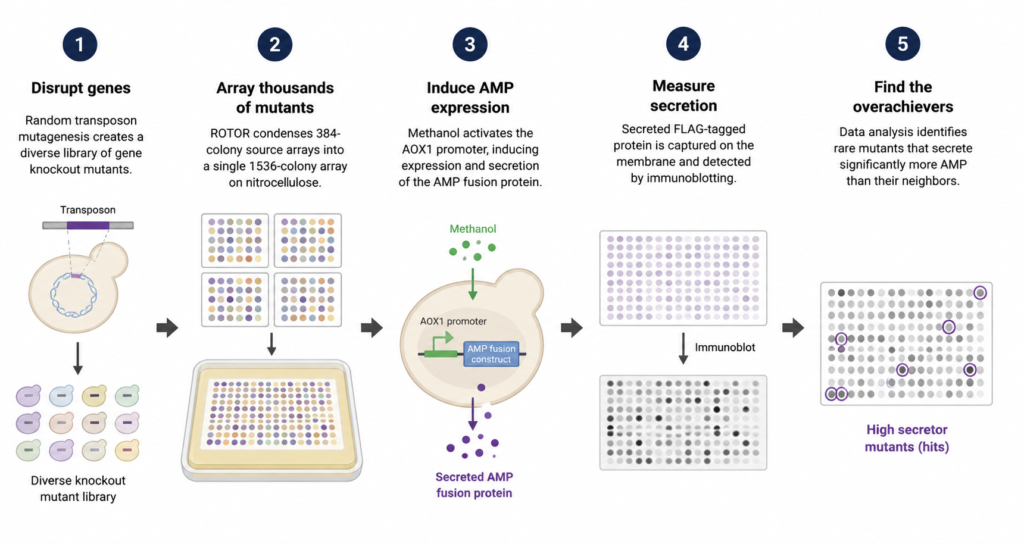
For the LOF screen, Dane used the Sleeping Beauty transposon system to randomly disrupt genes across the K. phaffii genome. Starting with an engineered strain unable to synthesise histidine, a selection marker within the transposon ensures that only cells which have undergone successful transposition can grow under selective conditions. Each insertion has the potential to disrupt a different gene, generating a diverse library that can be searched for mutations associated with increased AMP secretion.
But measuring AMP secretion presented another challenge. AMPs can be difficult to express directly, so Dane produces them as SUMO–FLAG–His fusion proteins. SUMO supports expression, FLAG provides a sensitive secretion readout and His enables downstream purification. Importantly, producing the AMP as part of a fusion protein can reduce its antimicrobial activity, making a direct activity-based assay less suitable for measuring secretion. FLAG immunodetection allows Dane to decouple secretion from bioactivity, measuring how much fusion protein each mutant secretes before the tags are subsequently cleaved to recover the active AMP.
The resulting mutants are initially arrayed at 384-colony density. ROTOR then condenses four 384-colony source arrays into a single 1536-colony array on nitrocellulose membrane, quadrupling screening density while reducing the number of plates, membranes and downstream blots required.
The membranes sit over methanol-containing media, activating the AOX1 promoter and inducing expression of the AMP fusion protein. After approximately 72 hours, secreted FLAG-tagged protein is captured on the membrane beneath each colony, leaving an individual secretion “footprint” that can be quantified by immunoblotting.
Figure 1: A schematic showing the high-throughput protein secretion screening done by Dane and co. at The University of British Columbia.
Finding the signal in the noise
A stronger signal didn’t automatically mean Dane had found a better secretor.
Differences in colony growth can influence the amount of protein detected, while colonies around the perimeter of high-density arrays can experience reduced competition for nutrients and consequently grow larger – the familiar edge effect.
To distinguish genuine secretion phenotypes from these positional and growth effects, Dane developed a custom Python pipeline that normalises secretion signal against colony size and position within the array. Statistical thresholds based on median absolute deviation can then highlight mutants producing substantially more secreted protein than comparable colonies.
As Dane explains:
“Screening on solid agar rather than directly into liquid makes it a lot easier to compare… you only need to correct for colony size, making it significantly easier to deal with.”
Dane will map the transposon insertion sites to determine which genes have been disrupted. Promising candidates will then be independently reconstructed using CRISPR/Cas9 and validated in liquid assays to confirm that the genetic change is responsible for increased secretion.
How many mutants does it take to find a better secretor?
A handful of mutants isn’t enough for a genome-wide search.
K. phaffii contains approximately 5,040 protein-coding genes and Dane’s modelling estimates that screening around 65,000 mutants would cover approximately 99.8% of coding base pairs, with more than 93% of genes having at least a 95% probability of being hit.
Suddenly, a relatively simple biological question becomes a substantial logistical one:
How do you reproducibly screen 65,000 individual yeast mutants for protein secretion?
65,000 mutants? Time to automate!
Performing the experiment manually is “possible, but not feasible.”
Dane began with manual pilot screens at 384-colony density, but scaling this approach exposed an important problem: variability. Differences in pin contact, pressure and positioning produced less uniform colonies, making subtle secretion phenotypes harder to distinguish. With ROTOR, Dane found automated arrays produced cleaner, more reproducible data, critical when searching for rare high secretors amongst thousands of mutants.
At 384 densities, the workflow would require four times as many plates and nitrocellulose membranes, and four times the immunoblotting, already one of the assay’s biggest bottlenecks. With ROTOR, four 384-colony arrays are condensed into a single 1536-colony array in minutes, quadrupling screening density while substantially reducing downstream processing. Combined with computational normalisation for colony size and edge effects, the workflow provides the consistency needed to distinguish genuine secretion phenotypes from experimental noise.
ROTOR doesn’t just stop high throughput from creating a high-throughput blotting problem. It provides the consistency needed to reliably find the rare secretion phenotypes hidden amongst thousands of colonies.
The results (so far)
The full genome-wide study is ongoing, but several important pieces of the workflow have already been demonstrated.
The team has established the 1536-format solid-phase secretion assay, and preliminary data show that it can reliably distinguish between high- and low-secreting colonies, while the custom Python pipeline normalises secretion signal to colony size to help separate genuine secretion phenotypes from differences in growth. Dane has also adapted the Sleeping Beauty transposon system to assess AMP secretion in K. phaffii. Together, these results establish the feasibility of taking the project into genome-wide LOF and GOF screening.
On the automation side, Dane has already observed a practical improvement over his earlier manual workflow: automated pinning produces cleaner, more uniform colony arrays and more interpretable data, while reducing the variability introduced by manual pressure and positioning. But perhaps the biggest difference is scale.
But for Dane, the impact of automation goes beyond saving time. It changes the scale of biological question that can realistically be asked. Instead of designing experiments around what can feasibly be processed by hand, high-throughput automation allows him to explore more conditions, extract more information from his research time and tackle experiments he previously might not have considered. If successful, the result won’t simply be a faster screening workflow. Dane’s research could provide a more systematic understanding of the genes and cellular mechanisms controlling recombinant protein secretion in K. phaffii, providing a foundation for engineering improved AMP production strains and potentially informing the production of other challenging recombinant proteins.
At 1536 density, the mutant library translates to only ~43 arrays rather than ~170 at 384 density. By condensing four 384-colony arrays into one, ROTOR therefore reduces not only plate handling but the membranes, immunoblots and downstream processing generated by the screen.
The challenge was never simply screening 65,000 mutants; it was making a biological question of that scale experimentally feasible.
Compared to using his previous manual approach, screening the same library would take a year.
Need to make the impossible research projects possible?
See the technology behind Dane’s high-throughput workflow