Defying natural selection: How A. lwoffii avoids evolution of antimicrobial resistance
Abi Sparks1and Professor Jessica Blair2 1 Singer Instruments, 2 University of Birmingham
Introduction
Understanding the evolution of antimicrobial resistance is one of the greatest challenges in modern microbiology. The idea that any bacteria can resist the pressure of natural selection seems absurd. Darwin would absolutely scoff at this idea. What makes it even more preposterous is that bacteria get hitched, move into a 2-up-2-down, reproduce and die all within 20 minutes. Darwin’s finches took millions of years to evolve beaks specific for each type of nut and seed available on the Galapagos Islands. A 20-minute life cycle means bacterial evolution happens at pace, and exposure to new selection conditions only hastens that evolution.
Mechanisms driving the evolution of antimicrobial resistance
In the lab, the group are looking at how various efflux pumps, including AcrAB-TolC, contribute to the evolution of antimicrobial resistance. To do this, they need to be able to measure how susceptible the different strains are to different antimicrobials. The lowest concentration of antimicrobial needed to kill or inhibit the growth of bacteria is termed the “Minimum Inhibitory Concentration” or “MIC”. The MIC can be determined using a standardised method – Agar macrodilution MIC.
One selector for resistance is exposure to antimicrobials. Natural genetic variation has over time allowed pathogenic species to select for protection against these antimicrobials, in the form of antimicrobial resistance. There are a multitude of mechanisms that they can exploit to achieve this. From mutating the microbial target so that the antimicrobial can no longer bind, to physically pumping the antimicrobial out of the cells using efflux pumps. It is no surprise that in the presence of such a strong evolutionary selection pressure, antimicrobial resistance has become of huge global concern.
“When you treat with an antibiotic, most of the bacteria will be killed. But some will survive, and they will grow and divide even in the presence of the antibiotic. Over time, these bacteria become more and more resistant to a variety of antibiotics, meaning that the infections caused by these resistant bacteria are more difficult to treat”.
However, as with anything, there’s one exception to the norm. Acinetobacter are renowned for their versatility and there are strains that are known to be clinically problematic – I’m looking at you Acinetobacter baumannii!
A. baumanii causes around a million infections a year and has a mortality rate of 35% (GARDP, 2026). With such a high mortality rate, it has a reputation in hospitals as one of the more problematic hospital-acquired infections. However, the other main contributor to clinical infection, the lesser-known Acinetobacter lwoffii, has remained susceptible to antimicrobials, despite causing up to 10% of Acinetobacter infections (Darby et al., 2024).
Professor Jessica Blair’s lab, at the University of Birmingham, have been trying to work out why on earth this is:
“So far it is unclear why A. lwoffii has managed to stay susceptible to antimicrobials. It seems to be highly selective about the DNA it acquires [by horizontal gene transfer] and therefore seems less willing to evolve resistance. We haven’t managed to evolve a resistant strain yet!”.
Determined to understand the mechanism behind A. lwoffii’s supposed perpetual susceptibility, Jess’ lab looked to scale up their experiments. Together, they collected over 90 strains to test against a range of antimicrobials, a commonly used assay called Minimum Inhibitory Concentration (MIC). Isolates were from a range of backgrounds (environmental, clinical and veterinary), to try and identify any strains that show reduced susceptibility to antimicrobials.
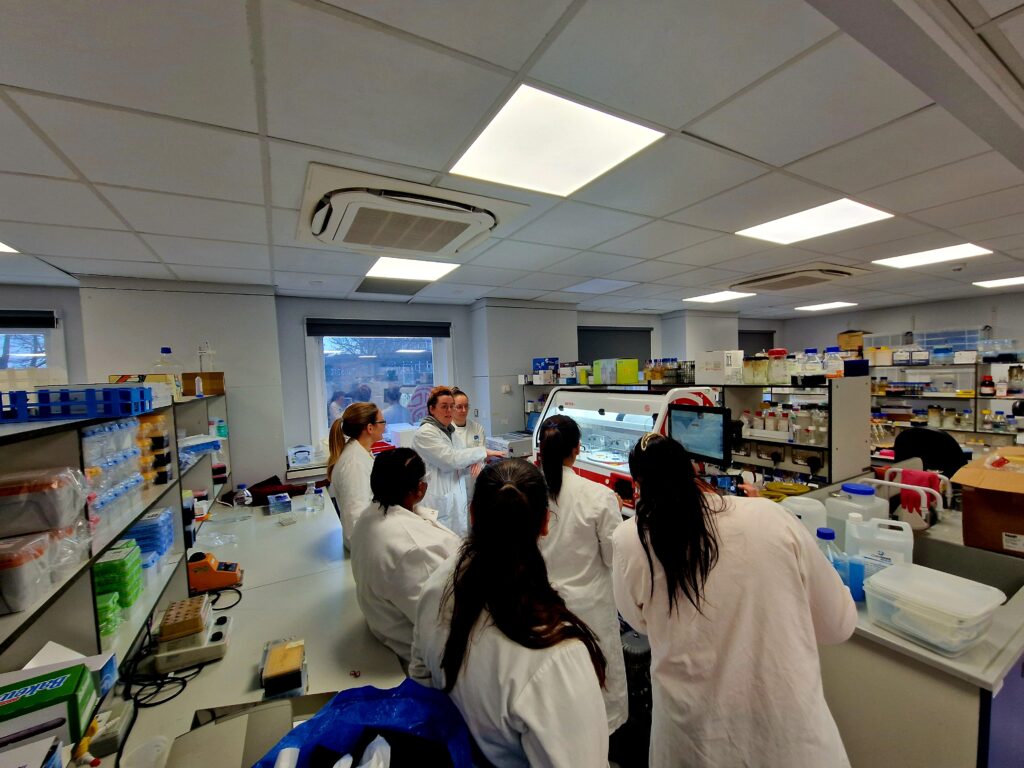
Figure 1: Our ROTOR+ Queen and resident scientist, Marina Serdar, showing the lab how to use ROTOR+ to run an MIC.
“ROTOR+ was a game-changer. We could fit all of our isolates in duplicate, and even had space for other labs to add on some of their strains too. This gives our data a real robustness and saves us not only time but also consumables money.”
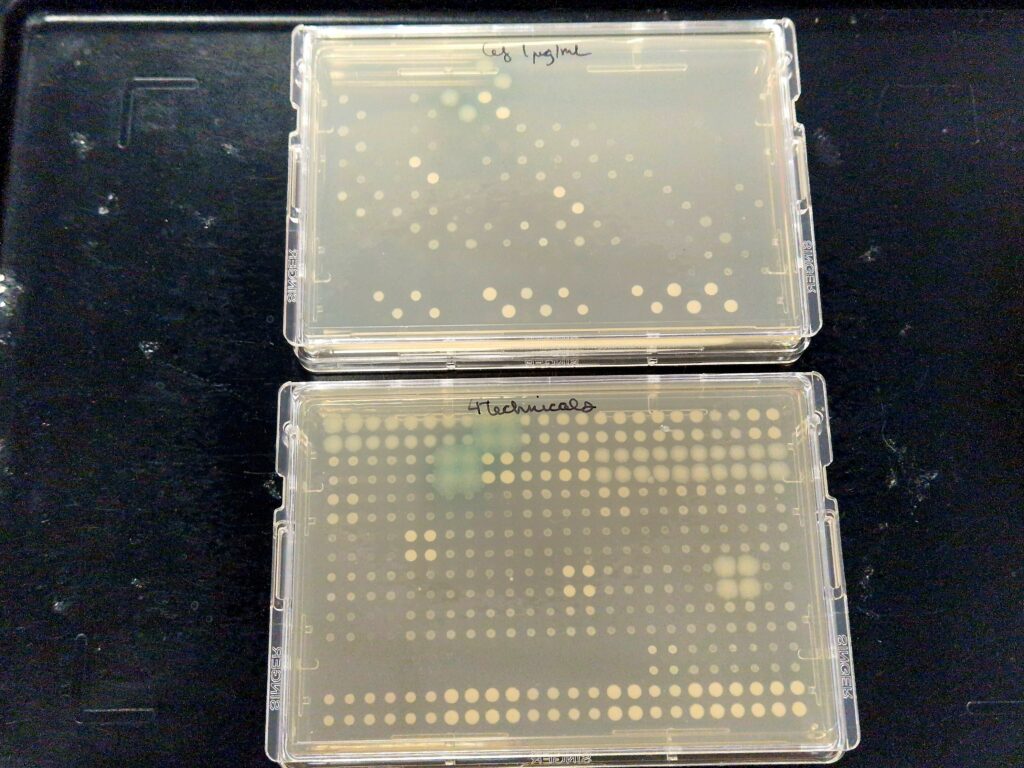
Figure 2: Two of the MIC result plates generated using ROTOR+. The top plate shows varying susceptibility to Cefotaxime (1µg/mL), with strains in duplicate. The bottom plate is a control plate showing 4x technical replicates of each strain pinned by ROTOR+ onto a PlusPlateTM . The group were able to screen over 90 isolates. Strains tested were a mixture of clinical isolates and genetically engineered strains.
What’s next for A. lwoffii?
The lab are hoping that by improving our understanding of A. lwoffii we might uncover the different drivers behind the evolution of antimicrobial resistance. It may even hold the key to reversing the development of antimicrobial resistance.
Need to do your own high-throughput MIC?
Check out our application note on how to do this with ROTOR+
Darby, E. M., Moran, R. A., Holden, E., Morris, T., Harrison, F., Clough, B., McInnes, R. S., Schneider, L., Frickel, E. M., Webber, M. A., & Blair, J. M. A. (2024). Differential development of antibiotic resistance and virulence between Acinetobacter species. mSphere, 9 (5), e0010924. https://doi.org/10.1128/msphere.00109-24
Abi Sparks is a microbiologist who swapped her lab coat for a keyboard as a Science Communications Specialist. She has a PhD in Molecular Microbiology and importantly, a golden retriever called Spud!