Unpicking efflux-mediated antimicrobial resistance with ROTOR+
Abi Sparks1and Professor Jessica Blair2 1 Singer Instruments, 2 University of Birmingham
Introduction
We are all (rightly so) terrified of antimicrobial resistance. With increasing global rates of multi-drug resistant infections (Naghavi et al., 2024), the relative dearth of new antimicrobial classes threatens to plunge us back into the pre-antibiotic era. Real-life superheroes, like Professor Jessica Blair at the University of Birmingham, are preventing this by furthering our understanding of how bacterial resistance develops. We recently visited their lab with ROTOR+ to see if we could streamline one of their largest assays – determining the Minimum Inhibitory Concentration (MIC).
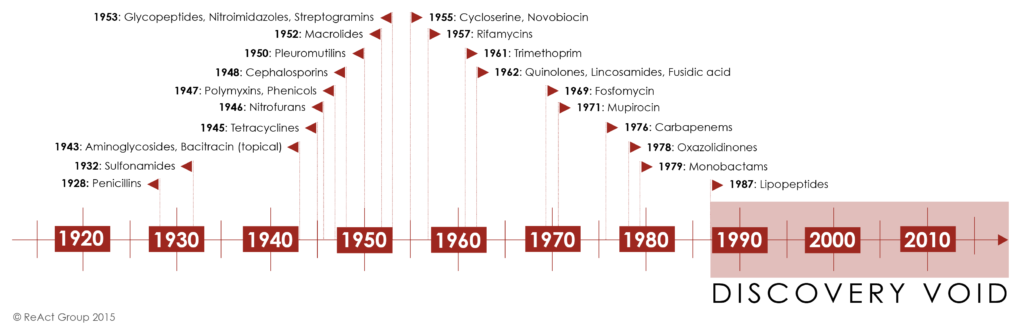
Figure 1: A timeline of the discovery of different antimicrobial classes in clinical use. The “Golden Era” of antimicrobial discovery uncovered multiple novel classes. There have been several new classes discovered in recent years (Macrocyclic peptides, Lasso peptides and Teixobactins), giving hope to the future of the development pipeline (Adapted from Silver, 2011).
What is antimicrobial resistance and how does it develop?
Jess explains that within a bacterial population, which may contain millions of different cells, there is natural genetic variation. This genetic variation allows the fittest to survive in conditions where there is a selection pressure – such as the presence of antimicrobials.
“When you treat with an antibiotic, most of the bacteria will be killed. But some will survive, and they will grow and divide even in the presence of the antibiotic. Over time, these bacteria become more and more resistant to a variety of antibiotics, meaning that the infections caused by these resistant bacteria are more difficult to treat”.
Specifically, Jess’ group studies efflux-mediated resistance. Bacteria are equipped with pumps – called efflux pumps – that physically pump out antimicrobials before they are able to have any effect. Overexpressing these pumps is one way that bacteria can become resistant to multiple classes of antimicrobial simultaneously. With enough of these pumps at work, antimicrobials cannot accumulate at a high enough concentration to inhibit the growth or kill bacteria.
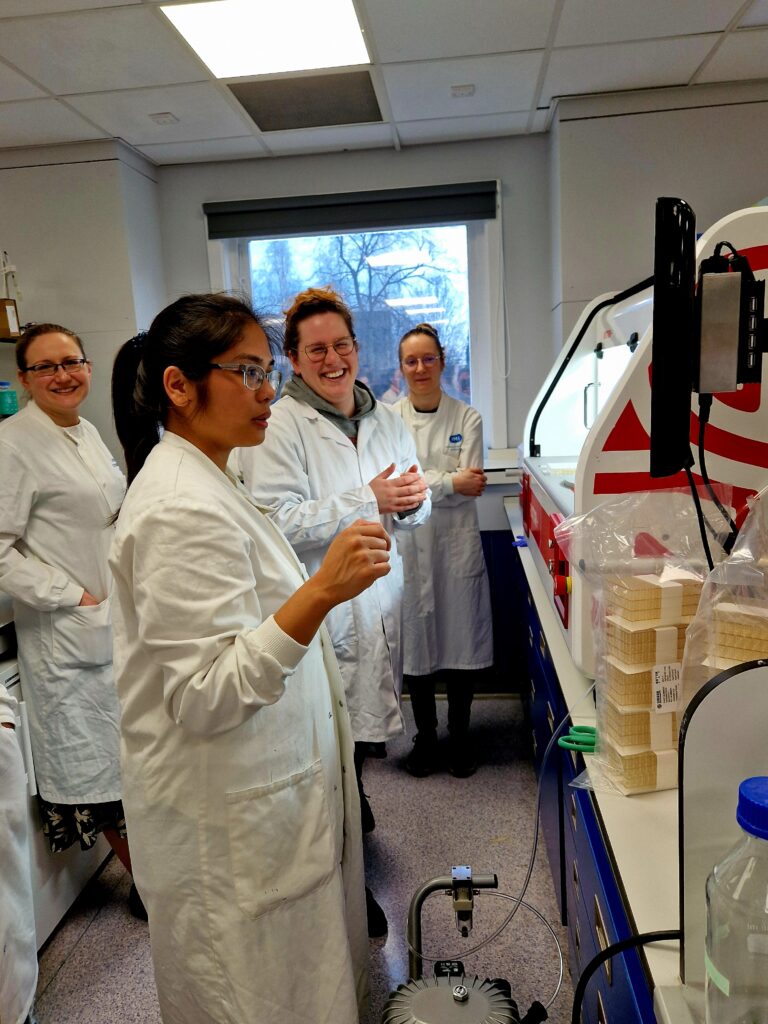
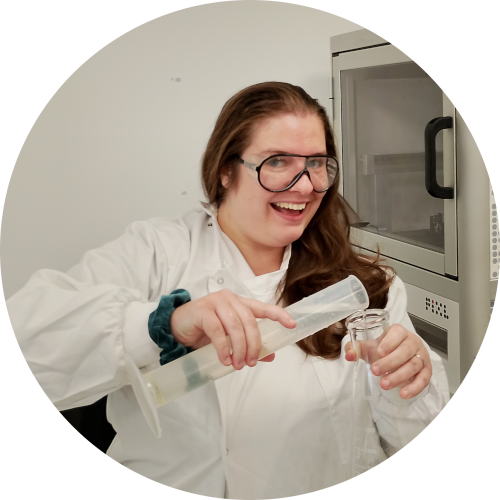
Figure 2: PostDoc Pauline getting hands-on with ROTOR+.
How can you measure efflux-mediated resistance?
In the lab, the group are looking at how various efflux pumps, including AcrAB-TolC, contribute to the evolution of and level of antimicrobial resistance. To do this, they need to be able to measure how susceptible the different strains are to different antimicrobials. The lowest concentration of antimicrobial needed to kill or inhibit the growth of bacteria is termed the “Minimum Inhibitory Concentration” or “MIC”. The MIC can be determined using a standardised method – Agar macrodilution MIC.
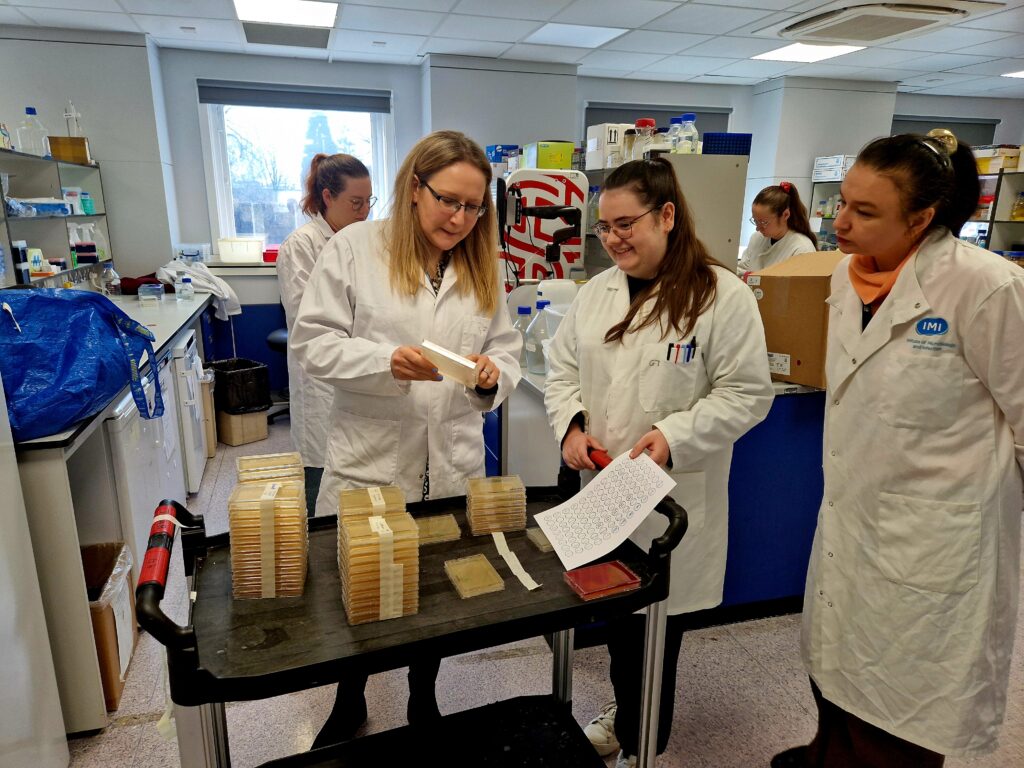
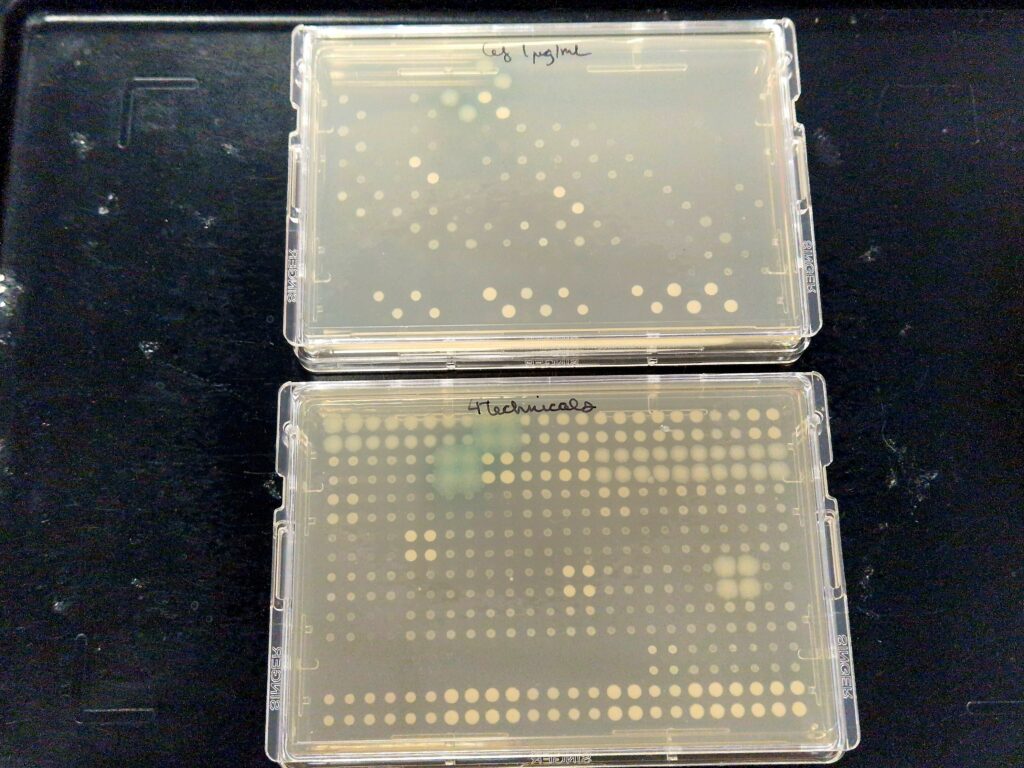
Figure 3: Prof. Jess Blair chatting through the results with her lab group. Figure 4: Two of the MIC result plates generated using ROTOR+. The top plate shows varying susceptibility to Cefotaxime (1µg/mL), with strains in duplicate. The bottom plate is a control plate showing 4x technical replicates of each strain pinned by ROTOR+ onto a PlusPlateTM . The group were able to screen over 90 isolates. Strains tested were a mixture of clinical isolates and genetically engineered strains containing mutations in efflux genes or their regulators.
Agar macrodilution – a better method for MIC determination?
Another common method to ascertain the MIC is via a broth microdilution assay, but Jess switched to agar macrodilution to reduce consumables costs and her lab’s environmental impact:
“We worked out that if we screened 96 strains against the antibiotics we wanted to test, it would take 72 multiwell plates to do the assay in broth. With all the tips needed, this is an insane amount of plastic. Being able to fit 100s of strains on an agar SBS plate (with technical replicates) means we only needed 1 PlusPlateTM per antibiotic concentration when we do the Agar MIC with ROTOR+.”
Now – having done my PhD in Jess’ lab, I can tell you first-hand how painful it can be to do a large-scale MIC. Sure, there was camaraderie: with the entire lab working together to get the MIC done it would have been a struggle without it! But by hour 6 of plate pouring, pinning and praying, we’d be the first to admit that we didn’t exactly look forward to them.
“I still remember having to stamp 96 strains using the metal pins and hoping they wouldn’t pierce the agar” – Student A, a glazed look in her eyes.
“Do you remember the time the pins went rusty?” Student B.
“Do you remember the time we had to use 50 bunsens to dry all the plates because the stamp was too wet?” Postdoc A, now a pyromaniac.
Doing an MIC with ROTOR+ felt like a true full-circle moment for me. Jess also highlighted the benefit of being able to get ROTOR+ to pin multiple technical replicates on a plate.
“ROTOR+ is amazing and it has saved us SO much time. Being able to scale up the throughput, and also include replicates all on the same plate, makes the data really robust”.
Naghavi, M., et al. (2024). Global burden of bacterial antimicrobial resistance 1990–2021: A systematic analysis with forecasts to 2050. The Lancet, 404(10459), 1191–1226. https://doi.org/10.1016/S0140-6736(24)01867-1
Darby, E. M., Trampari, E., Siasat, P., Gaya, M. S., Alav, I., Webber, M. A., & Blair, J. M. A. (2023). Molecular mechanisms of antibiotic resistance revisited. Nature Reviews Microbiology, 21(5), 280–295. https://doi.org/10.1038/s41579-022-00820-y
Need to do your own high-throughput MIC?
Check out our application note on how to do this with ROTOR+
Abi Sparks is a microbiologist who swapped her lab coat for a keyboard as a Science Communications Specialist. She has a PhD in Molecular Microbiology and importantly, a golden retriever called Spud!