PIXL Max Picking Efficiency Report
Emmy Hawkins1, Marina Serdar1 – 1Singer Instruments, Roadwater, UK
Introduction
Robust picking efficiency is the cornerstone of reliable automated colony picking, giving scientists true walk-away capability while ensuring no colony is missed. The PickupLine™ is a versatile pin tool that enables PIXL systems to pick across a wide range of model and non-model microorganisms without exchanging hardware.
Thanks to PickupLine™ technology, PIXL Max easily adapts to diverse organisms, whether bioprospecting filamentous fungi (like at Isomerase) or biobanking thousands of slow-growing human microbiome strains at the AHMB. Here we present the performance of PIXL Max when picking standard laboratory strains representing typical bacterial and yeast colony morphologies: Escherichia coli and Saccharomyces cerevisiae.
Results
Picking efficiency was investigated on three PIXL Max instruments under standard laboratory conditions using default pinning settings. Efficiency was defined as the percentage of successful pins that resulted in colonies after the specified incubation period, recording any missing colonies on 1536-format SBS plates (Figure 1). Both Saccharomyces cerevisiae and Escherichia coli were picked and pinned 18,432 times in both liquid-agar and agar-agar transfer modes. All colonies were successfully transferred and cultured, with PIXL Max achieving 100% picking (transfer) efficiency for both organisms tested (Table 1).
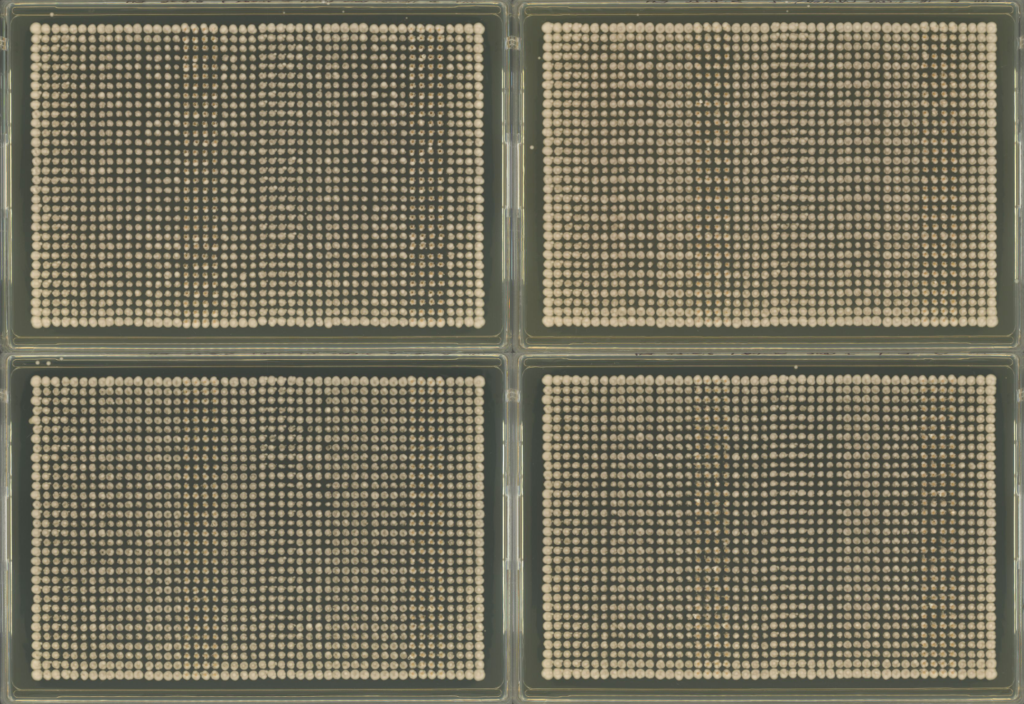
Figure 1. High density arrays of S. cerevisiae and E. coli are successfully created in agar-agar and liquid-agar modes using PIXL Max six-channel pinning. Four representative target plates used to assess colony outgrowth are shown from an S. cerevisiae replicate on PIXL Max.
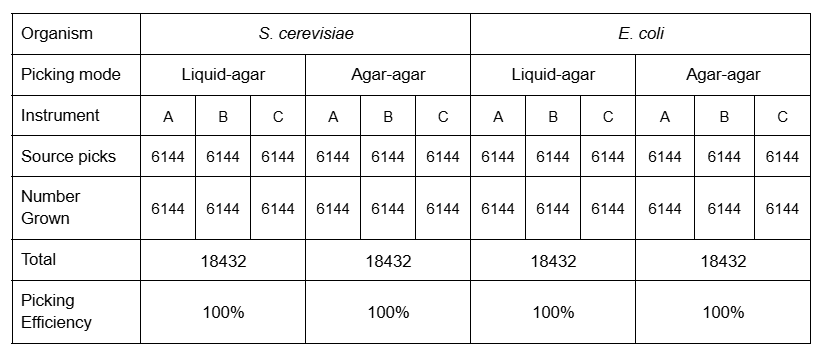
Table 1. PIXL Max is exceptionally effective at transferring yeast and bacteria from liquid to agar and agar to liquid at default pinning settings. Raw picking efficiency data is presented for all colonies picked by PIXL Max for both tested strains with final efficiency values. Total efficiency for PIXL Max was calculated from the sum of grown colonies relative to the picked colonies.
Discussion
These experiments measured picking efficiency of the newly launched PIXL Max – the six-channel spiritual successor of PIXL. While it reuses the core PickupLine™ pin tools, the six-head configuration introduces challenges to maintain accuracy of mechanical transfers during high-speed pinning. The efficiency test results demonstrate this is not a concern when picking with six channels simultaneously, even at high densities with small colonies.
Three instruments were evaluated to confirm the findings with technical replicates, with liquid-agar spotting and agar-agar transfers across two media types and two organisms.
Method
Picking efficiency (also known as transfer efficiency) was tested by repeatedly transferring 1,536 colonies (averaging ~1mm in diameter and ~1mm apart) from an arrayed source plate to an empty SBS target plate containing 2% agar (agar-agar transfer). PIXL Max was run under standard operating conditions using default settings. Source plates were prepared by arraying a 15 mL liquid overnight culture onto 2% agar SBS plates (liquid-agar transfer). LB agar was used for E. coli MG1655, while YPD agar was used for S. cerevisiae Ysar371. Colony outgrowth was assessed after incubation at 30°C – overnight for E. coli and 48 hours for S. cerevisiae. For both liquid-agar and agar-agar transfers, transfer efficiency was calculated by dividing the number of successfully grown colonies on the target plate by the number of colonies on the source plate.
Explore PIXL Max’s Supercharged technology
S̶i̶z̶e̶ Speed isn’t everything. Picking the right colonies takes real intelligence.
PIXL Max pairs six-channel high-speed pinning with AI-driven vision to identify,
morphologically analyse, and pick colonies with flawless precision.